

PExA Founder Interviewed in Sweden’s Largest Regional Newspaper Göteborgs-Posten – Focus on Early Detection of Lung Disease
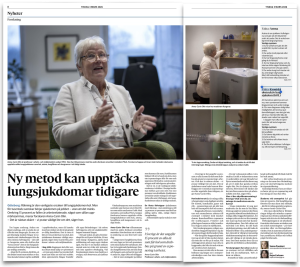
Professor Anna-Carin Olin, founder of PExA and Professor of Occupational and Environmental Medicine at the University of Gothenburg, has been interviewed in the Swedish newspaper Göteborgs-Posten about how lung diseases may develop in the small airways long before they can be detected using current methods.
“In Sweden, approximately 15 percent of all people who develop COPD do so due to exposure in the workplace,” says Anna-Carin Olin in the interview.
In the article, she explains how disease processes often begin in the peripheral parts of the lung – the small airways – an area that current methods have limited ability to capture at an early stage.
COPD (chronic obstructive pulmonary disease) is one of the leading causes of death globally. In Sweden, it is estimated that between 400,000 and 700,000 people live with the disease, many of whom remain undiagnosed.
- These are diseases that could have been prevented if exposure had been reduced or if they had been detected earlier, she emphasizes.
The article also describes how researchers hope that the PExA method may help detect diseases such as COPD, asthma and lung cancer at an earlier stage, and that the technology could potentially be used as a simple screening test in the future.
- It is very encouraging to see the importance of the small airways now being highlighted in major newspapers. The research that Anna-Carin Olin has been driving for many years is fully aligned with the growing need for methods capable of identifying biological changes before disease has progressed too far, says Tomas Gustafsson, CEO of PExA.
Occupational exposure – enabling action before damage becomes irreversible
A central theme in the article is the occupational health perspective. Harmful changes in the small airways can develop gradually over long periods without obvious symptoms. If biological changes can be detected early, it creates an opportunity to act before the damage becomes permanent.
In some cases, the measures required may be relatively simple – such as reducing exposure, improving protective equipment, modifying the work environment or temporarily removing workers from exposure.
Interest in this type of preventive monitoring is increasing, particularly in industries where exposure is part of the working environment. A younger generation of workers is also generally more aware of health risks, which may influence how employers approach preventive health monitoring in the future.
Today, PExA technology is already used by several national authorities and leading research institutions worldwidestudying the effects of occupational exposure and other risk factors related to lung disease.
A technological paradigm shift enabling biomarker development
The PExA method enables the non-invasive collection of microscopic droplets originating from the small airways through a standardized breathing maneuver. The collected material can then be analyzed to study biological changes at the molecular level.
In recent years, advances in molecular and biochemical analysis have reached a level where very small sample volumes can be analyzed with high sensitivity at a reasonable cost. This development has created new opportunities to conduct meaningful biomarker studies using material from the small airways.
For the first time, biological signals can be identified in a systematic and reproducible way, which has resulted in the identification of biomarker candidates in areas such as lung cancer, as well as in studies related to pharmacokinetics and pharmacodynamics (PK/PD).
PExA has filed a patent application covering biomarker patterns for early detection of lung cancer based on analysis of material collected using the company’s method.
- The technological advances mean that we are now in a position where biological patterns in the small airways can actually be identified in ways that were previously not possible. As a result, research findings are beginning to emerge and interest from new actors is increasing. This creates a platform for continued work toward future diagnostic applications, for example in lung cancer, says Tomas Gustafsson.
Read the full article in Göteborgs-Posten (Swedish).
https://www.gp.se/e7bca7cb-d358-4406-9ed5-311be935628f
For further information, please contact:
Tomas Gustafsson, CEO, info@pexa.se
About PExA AB:
PExA AB PExA AB (556956-9246) has developed the PExA 2.1, a patented research instrument that helps researchers intelligently collect biological samples from the smallest airways through a simple exhalation maneuver. PExA’s technology is currently used by prominent research groups in several different countries and research with the instrument has resulted in approximately 50 scientific publications, which serve as reference material for PExA’s method. The company’s long-term goal is to market and sell diagnostic instruments for popular diseases (e.g. lung cancer and COPD) to be used globally for diagnosis or general screening at facilities where care is offered. The company intends at the time it is relevant to sell to clinics to have developed more patient-friendly, flexible and commercial products, which means that PExA addresses a significantly wider market, which today includes several million patients globally.
PExA’s B share is listed on the Spotlight Stock Market.