

Additional funding strengthens a growing research environment in Örebro where PExA is used in multiple studies
PExA announces that the Company’s instrument and method are playing an increasingly clear role in the growing research environment at Örebro University and Region Örebro County, focused on occupational particle exposure and early biomarkers of lung effects.
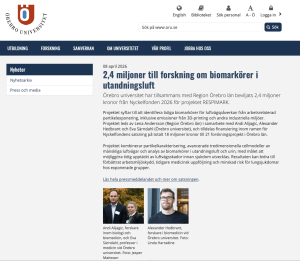
Örebro University and Region Örebro County have been awarded SEK 2.4 million from Nyckelfonden 2026 for the RESPIMARK project. The project aims to identify early biomarkers of airway effects caused by occupational particle exposure, including emissions from 3D printing and other industrial environments. The project includes biomarker analysis in exhaled breath and urine, with the goal of contributing to earlier detection of airway damage before disease develops.
RESPIMARK builds on a research environment where PExA is already used in, among others, NanoSafety 2, which investigates health effects from residual particles generated by 3D printing, and BioBreath, which focuses on quartz dust exposure in foundry environments and its impact on lung health.
- RESPIMARK is part of our broader effort to identify early biomarkers of airway effects caused by occupational particle exposure. By combining different experimental models and biomarker analyses, we hope to contribute to earlier detection of airway damage and a better understanding of how industrial particle exposure affects lung health, says Andi Alijagic, Assistant Professor in Precision Toxicology at Örebro University.
For PExA, this development is a clear example of how the Company’s instrument and method are gaining increased importance in research aimed at understanding early biological effects of harmful exposure in occupational settings. It reflects continued and expanded use of the PExA system already installed in Örebro, as the research broadens and deepens.
- We would like to congratulate the researchers in Örebro on receiving additional funding for important research in occupational health and lung health. For us, it is very encouraging to see how PExA is becoming involved more and more in their work. Research that can contribute to earlier detection is important, not least because part of the disease burden in conditions such as COPD is linked to exposure in the work environment. This strengthens our view that our method has a relevant role in research aimed at understanding early effects in the small airways,says Tomas Gustafsson, CEO of PExA.
Taken together, these projects illustrate the growing importance of PExA’s instrument and method in research on occupational exposure, biomarkers, and early signs of lung effects.
For further information, please contact:
Tomas Gustafsson, CEO, info@pexa.se
About PExA AB:
PExA AB PExA AB (556956-9246) has developed the PExA 2.1, a patented research instrument that helps researchers intelligently collect biological samples from the smallest airways through a simple exhalation maneuver. PExA’s technology is currently used by prominent research groups in several different countries and research with the instrument has resulted in approximately 50 scientific publications, which serve as reference material for PExA’s method. The company’s long-term goal is to market and sell diagnostic instruments for popular diseases (e.g. lung cancer and COPD) to be used globally for diagnosis or general screening at facilities where care is offered. The company intends at the time it is relevant to sell to clinics to have developed more patient-friendly, flexible and commercial products, which means that PExA addresses a significantly wider market, which today includes several million patients globally.
PExA’s B share is listed on the Spotlight Stock Market.