

PExA receives broad attention in Australia – seen as having significant potential for earlier detection of silicosis
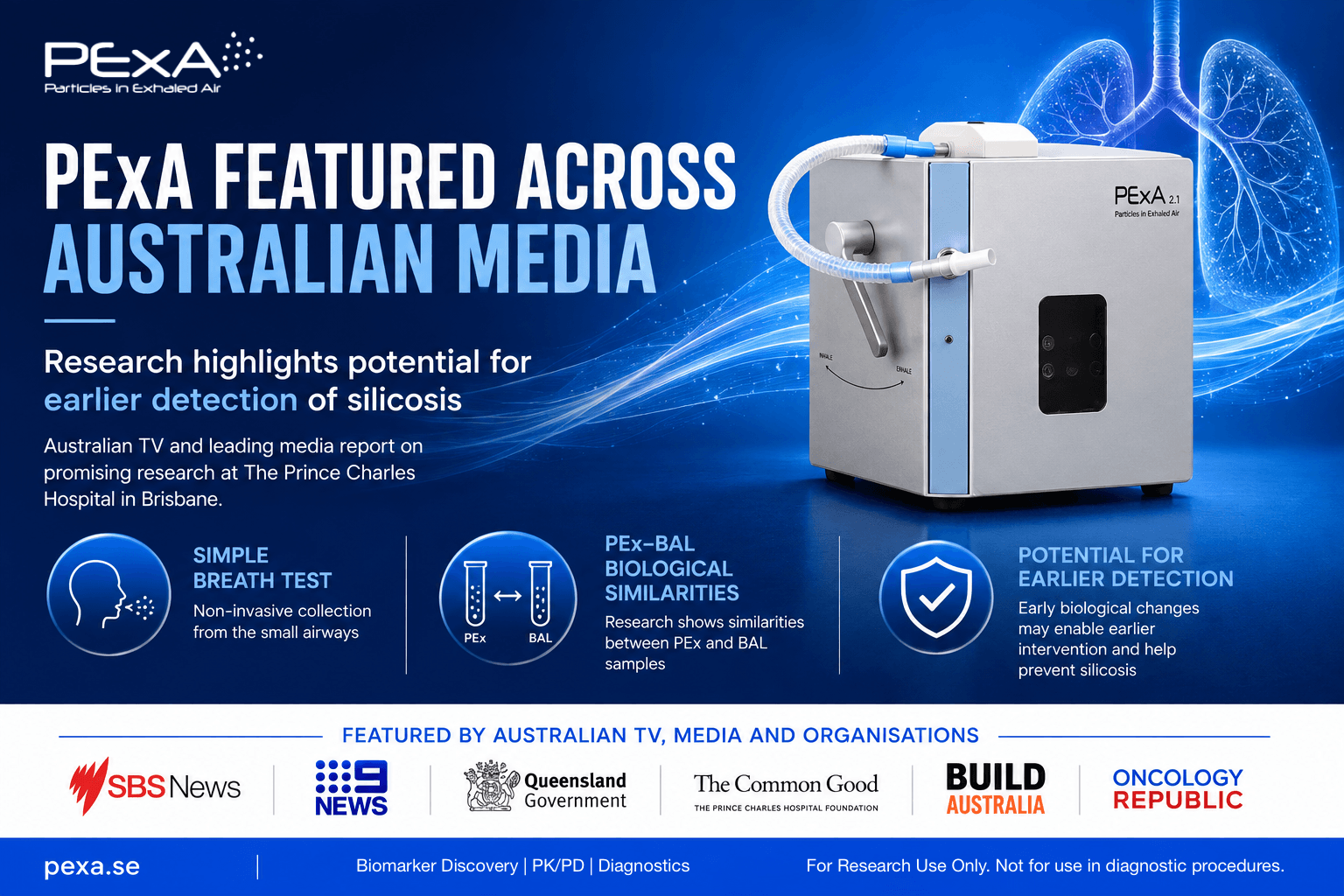
PExA’s technology is receiving broad attention in Australia following promising research at The Prince Charles Hospital in Brisbane. Researchers see potential for a simple, non-invasive breath test to identify early biological changes associated with silicosis – potentially enabling earlier detection and, in the longer term, helping to prevent the disease.
During the summer, the research has been featured in several Australian TV broadcasts, including SBS World News and Channel 9/9News, as well as by the Queensland Government and Australian industry and medical media. The focus is on the potential to use a simple, non-invasive breath test to detect early biological changes associated with silicosis – before severe and irreversible lung damage has developed.
PExA has an established collaboration with the Queensland Lung Transplant Service at The Prince Charles Hospital. In August 2025, PExA announced that, following an earlier evaluation phase, the collaboration had been expanded through a rental agreement for the PExA 2.1 system and a formal data-sharing collaboration. Anonymised technical data from the study are shared with PExA and contribute to the company’s growing knowledge base on biological markers in the small airways.
Silicosis is a serious and irreversible lung disease caused by inhalation of very small particles of crystalline silica. Exposure occurs across a wide range of occupations, from construction and industrial workers to stonemasons and miners. An estimated 600,000 Australians are exposed to silica dust at work each year.
The research team at The Prince Charles Hospital is investigating whether PExA can be used to identify early biological changes in people exposed to silica dust. PExA non-invasively collects microscopic particles from the small airways through a simple breathing manoeuvre. These particles contain biological material, including proteins, which can subsequently be analysed to search for early disease signatures.
Traditionally, sampling from the deep regions of the lungs has required considerably more invasive procedures, such as bronchoscopy with bronchoalveolar lavage (BAL), performed in a hospital setting. The research team has compared matched samples from PExA, BAL and blood to investigate how well the biological content obtained through the simple breath test reflects the information obtained through more invasive sampling. The results of this comparison are now being prepared for scientific publication.
Professor Daniel Chambers at The Prince Charles Hospital highlights in the TV coverage the contrast between traditional invasive lung sampling and PExA’s simple breath test. He also describes how the research has demonstrated similarities between the material obtained using PExA and that obtained through invasive sampling methods.
According to Chambers, the potential extends beyond diagnosing silicosis at an earlier stage. If early biological changes can be identified before irreversible lung damage has occurred, this could provide an opportunity for earlier intervention and potentially even prevent exposed individuals from developing the disease.
“It is very encouraging to see the attention that both the research and PExA are now receiving in Australia. We have been working with the Brisbane group for some time, and it is particularly interesting that they are comparing material from our simple, non-invasive breath test with considerably more invasive lung sampling. The possibility of identifying biological changes in the small airways before serious disease has developed very clearly demonstrates the potential we see in PExA technology,” says Tomas Gustafsson, CEO of PExA.
The research is supported by The Prince Charles Hospital Foundation through its Tradie Health Institute, which focuses on occupational health in sectors including construction, mining and industry. The researchers also have a stated vision that, in the longer term, the technology could be used in a portable format for on-site screening of people working in high-risk occupations.
The continued research has also received support from industry. Australian construction company CPB Contractors has contributed AUD 300,000 over three years to the next phase of the research programme.
The research and PExA have received coverage from, among others:
- SBS World News – TV coverage of the silicosis research and PExA
- Channel 9 / 9News – TV coverage from The Prince Charles Hospital
- Queensland Government / Metro North Health – World-first research offers hope for earlier occupational lung disease diagnosis
- The Prince Charles Hospital Foundation / The Common Good – Protecting the lungs of Australia’s tradies
- Build Australia – coverage of PExA and the silicosis research
- Oncology Republic – coverage of research into earlier detection of silicosis
For further information, please contact:
Tomas Gustafsson, CEO, info@pexa.se
About PExA AB:
PExA AB PExA AB (556956-9246) has developed the PExA 2.1, a patented research instrument that helps researchers intelligently collect biological samples from the smallest airways through a simple exhalation maneuver. PExA’s technology is currently used by prominent research groups in several different countries and research with the instrument has resulted in approximately 50 scientific publications, which serve as reference material for PExA’s method. The company’s long-term goal is to market and sell diagnostic instruments for popular diseases (e.g. lung cancer and COPD) to be used globally for diagnosis or general screening at facilities where care is offered. The company intends at the time it is relevant to sell to clinics to have developed more patient-friendly, flexible and commercial products, which means that PExA addresses a significantly wider market, which today includes several million patients globally.
PExA’s B share is listed on the Spotlight Stock Market.